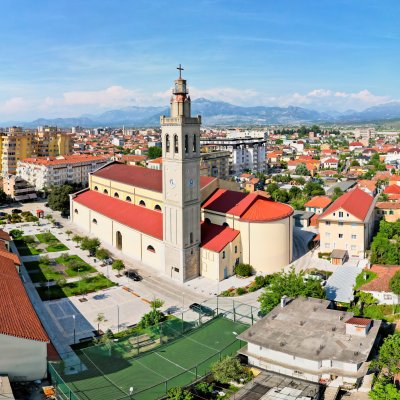
MUZEU DIOQEZAN SHKODER-PULT Shkodër
Sheshi Gjon Pali II, Shkodër 4000
4000 Shkodër Shkodër
Albania
17:00
17:00
17:00
17:00
17:00
17:00
17:00
Are you the owner of this business?
Suggest an edit
Museum


MUZEU DIOQEZAN SHKODER-PULT Shkodër
DETAILS
Visit to the museum (Point)
OPENING HOURS Every day: 09:00 - 17:00 For bookings outside of opening hours, contact via e-mail or by phone number ADMISSION TO THE MUSEUM Since the purpose of the Museum is only educational, the entrance ticket is 100 Lek (€ 1.00). GUIDED VISITS Booked visits Guided visits can be booked by phone on the days when the museum is open through telephone and e-mail. Cancellation of reservations Cancellations must be communicated by telephone at least 48 hours in advance. SERVICES FOR THE PUBLIC Bookshop On the ground floor you can find leaflets, pocket guides, postcards and various publications to deepen your knowledge of the museum's collections. Educational services Through a wide and varied offer, the Diocesan Museum is open to different categories of the public: school students without distinction, adults (locals or tourists), families, parishes, associations, etc. The museum is open to undertake specific projects with schools, organizations and various entities. Availability of museum spaces Requests can be made for the availability of museum spaces in the multimedia hall (once completed) for the organization of conferences, meetings and book promotions. To find out more about the fees for the release of spaces, you can write to the director. Audio guides Visitors are offered the service of audio guides in 9 different languages. It is possible to connect via smartphone to the link given at the entrance using this service for free. It is advisable to use personal limits.
Regulation (Area)
Food and drinks are not allowed in the museum halls. Animals are not allowed, with the exception of companion dogs for blind people. Smoking is not allowed. PHOTOGRAPHY AND VIDEO In the exhibition halls of the museum, amateur video and photography (without flash) can be taken that can You can also share them on the museum's social platforms. Professional filming for commercial purposes must be authorized by the directorate. For authorization, please write an e-mail to the museum.
About museum (Area)
The Diocesan Museum arises from the need to collect, preserve and make available the historical heritage related to the religion and culture of the Albanian people, which specifically refers to the territorial area that is part of the Archdiocese of Shkodër-Pult
Thematic sections (Area)
Itinerari ekspozues është i organizuar në 16 seksione tematike, me një ecuri tregimtare që vlerëson dhe lë të “flasin” sende dhe materiale të ekspozuara, dhe të organizuara në dy bërthama: VENDE DHE SHENJA NË KOHË (kati përdhes) dhe ZËRA, FYTYRA DHE DËSHMI NË KOHË (kati i parë). Organizimi sipas seksioneve synon të ndihmojë lexueshmërinë e itinerarit të muzeut, si dhe “përfshirjen” e vizitorit nëpërmjet një itinerari njohës. Tekstet dhe komentet e itinerarit janë në shqip dhe anglisht dhe seksionet do të pasurohen me instrumente multimediale për thellim, me figurë dhe zë.
exhibition and mult... ... (Area)
Exhibition elements of particular importance are the Statue of the "Sorrowful Lady" at the entrance, the wooden Cross which, together with the two statues of Saint Anthony and the Heart of Jesus, testify to the "resistance" of the faith against the attacks of the dictatorship and the statue of San Prospero, whose history is described in a special didascali. The exhibition of numerous sacred vases and of varied glazes defines the path of this hall, accompanying the visitor to the encounter with these testimonies not of a past time, but of a living and present memory that has touched and marked the existence of men and women "witnesses of the faith".
Pinakoteka mission (Area)
Since the Church has existed, the artistic aspect has always been a tool for the transmission of religion: the mosaic, musical and scenic art have turned out to be the privileged tools for the proclamation of the Gospel. In particular, pictorial art, especially when used to decorate churches, has also been defined as the "Bible of the poor", that is, of those who, not knowing how to read or write, had the opportunity to know the biblical passages thanks to works of painters who have left their mark in the history of world art. Culture is also an "aeropag", a meeting place between the religion of believers and those who do not believe; dialogue table about beauty, in the construction of a more humane and livable world. Thus, the cultural center of the Church of Shkodër-Pulti, active and active with the Diocesan Museum, also includes this Pinakothek dedicated to one of the greatest exponents of pictorial art: LinDelia , the son in exile of this land. Pikanoteka was born from the meeting of Monsignor Massafra with Mons. Eleuterio Fortino, arborist and collector of several works by Master Lin Delija. After his death, the heirs had the pleasure of bringing this Fund of Delia's works to Shkodër, the birthplace of the Master, which is added to a previous gift of sketches, made a few years earlier thanks to the interest of Armando Nicoletti and Giuseppe Grassi- t, exponents of the "Lin Delija" Cultural Association in Antrodok (Italy), the place where the Master spent the last years of his life. With these two donations, the creation of this small Pinakoteka was made possible, which shows Delia's love for his land, his pain for because of the distance from the homeland and his hope for a free Albania in the sign of a renewed religion.
The nature of the ex... ... (Area)
It is a group that belongs to the author's creativity of the early 80s, mainly between '80 and '83. It is about a period when Delija switched to the tempera technique. He was forced to abandon the oil technique due to health problems, due to the allergy he had to tempertin, which is a component of this technique. From a thematic point of view, this group of paintings can be divided into 2 main groups where the first is thematic religious and the second is the theme of persecution in Albania in those years. As for the first group, of religious themes, it is a line present in a constant way in the author's creativity. There is a consistency in this direction. Regarding the second group, of persecution, we see an artist engaged from a political point of view. The debate about engagement in politics is a debate that is present throughout the history of art. Of course, this debate has had its fluctuations throughout history. In general, today there is a positive opinion in favor of the engagement of the artist Delija, especially in the social aspect, and in this prism we see an author who is active and engaged in the political point of view. In terms of the stylistics of his works, we can to say in summary that there is an influence of the modernist figuration of the beginning of the 20th century. Of course, these currents also had their development in Italy before the war. We must bear in mind that the teachers of Delia in the Academy of Rome were themselves part of the developments of these modernist currents in the 20s and 30s in Italy. Then, beyond the influences and form that Lini received from the Italian school, there is always his individuality in the treatment of brushwork, in the treatment of what are called spots in painting, which is the distribution of colors and tones. It is this stamp of his identity, which gives the unique characteristic to his work and is an important part of the success he has as an artist.
More tours nearby
Pedonalja Shkoder
Biblioteka Franceskane "At' Gjergj Fishta"
Kulla e Gjon Markagjonit
Kulla e Gjon Markagj...
"Marubi" National Museum of Photography.