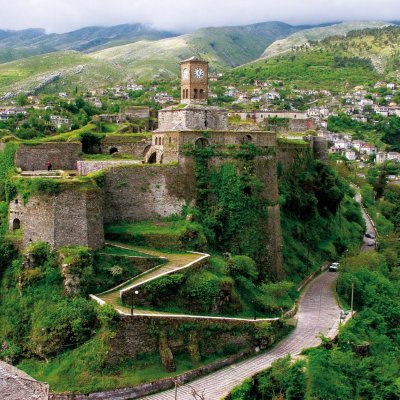
Castle of Gjirokastra Gjirokastër
Rruga Elvia Celebi
Gjirokastër Qarku i Gjirokastrës
Albania
www.gjirokastra.org/sub_links/visiting_sub/visiting_castle.html
19:00
19:00
19:00
19:00
19:00
19:00
19:00
Are you the owner of this business?
Suggest an edit
Tourism


Castle of Gjirokastra Gjirokastër
DETAILS
Gjirokastra castle (Area)
Gjirokastra Castle is the most impressive structure of this stone town and definitely the point from which you can enjoy it from all four sides, as well as the spectacular views of the Drino river valley and the surrounding mountains. Its existence is thought to be early, although it is mentioned for the first time in 1336. According to historians, the first walls of the fortress may have been built after the fall of the ancient city of Adrianople. The castle received the architectural expression it has today during the ruling period of Ali Pasha Tepelena; the main designer and implementer was his trusted chief architect, Petro Korçari. This fort, built on a rocky massif, extends over 335 meters in length. According to various researchers, who break down the architectural concept in its genesis, the castle was protected by 7 towers with a height of 30 meters and traversed by 4 entrances, 3 of which were main entrances and 1 was secondary; there are underground galleries that lead everywhere in the fort, while at the time they added strength and resistance to its structure. Today, there are several tourist attractions within it, such as the National Museum of Armaments or the Prison of the Seven Windows.
Symbol of the city (Point)
What you see at Gjirokastra Castle today are the most recent layers of a 1.500 – year history – much of which is still stepped in mystery. Gjirokastra Castle offers a rich store of stories from across the ages. Look for the panels placed along the main paths to discover the highlights. To find out more, visit the Museum of Gjirokastra and the Arms Museum (see the map). Visitor Information 1000 m Walking distance to visit each end of the castle 1 hour Estimated time to visit the castle, without the museums 2.5 hours Estimated time to visit the castle, with both museums Much of the walkway through the castle is fairly level, through it is paved with the original rough cobblestones. Use care when walking on uneven surfaces. There are a few areas of the castle that can only be accessed via stairs. These include the Bektashi tomb to the right of the main entrance, the Ottoman ovens, the Museum of Gjirokastra, the Arms Museum and the prison.
Monument of the peop... ... (Point)
Odhise Paskali (1903 – 1985) This statue of a partisan represents the resistance fighters that opposed the Fascist Italian and Nazi German occupation of Albania during World War II. The partisans were celebrated for liberating Albania from the invading forces. Albania’s communist dictatorship commissioned many nationalistic statues, like this one. In this way, the regime sought to identify its aims and motivations with those of the partisans, and gain popular support for its control of the country. Odise Paskali, known as the founder of Albanian sculpture, produced hundreds of works. Among them are the statue of the independence fighter Cerciz Topulli in the main square of Gjirokastra and the monumental statue of George Kastriot Skanderbeg that stands in the centre of Tirana. Photo: The statue here in the castle is a copy. The original version, called Monument of the People’s Power, was placed in Permet in 1964. (Gallery of Figurative Arts Tirana).
Tanku italian fiat... ... (Point)
This little tank is a remarkable survivor. It is one of only three remaining tanks of its type in the world, out of 283 commissioned by the Italian forces in World War II. Designed for reconnaissance, the Fiat L6/40 was forced into combat to make up for the Italian army’s shortage of medium battle tanks. Unsuited to frontline conflict, many were destroyed in action. Those that survived the war were gradually phased out and recycled for scrap. This tank was recovered from Borsh on the Southern Albania coast, in order to be displayed at the Arms Museum.
Former ottoman – era... ... (Point)
Down these stairs, you can see the remains of several ovens from the Ottoman – era. When people lived in the castle, these ovens would have been operating almost constantly, producing bread to feed the soldiers of the pasha. This kind of wood-fired oven is still in use today. Look for them churning out pizzas and byrek (a kind of traditional savory pie) in the bazaar below the castle.
Ali pasha's power ga... ... (Point)
"Napoleon has twice offered to make (Ali) King of Epirus, but he prefers the English interes and abhors the French as he himself told me. He is of so much consequence that he is much courted by both, the Albanians being the most warlike subjects of the Sultan…” Lord Byron, English poet, 1809 Ali Pasha of Tepelena ( 1740 – 1822) was a forceful Albanian ruler who controlled large parts of the Ottoman Empire’s European territories. During his reign over Gjirokastra, from 1811-1820, the castle housed a strong military garrison. These cannons tell a tale of foreign relations between the Ottoman and British Empires, and Ali Pasha’s quest for supremacy. Providing support in the form of arms was as central to international power play in the past, as it is now. The sultans of the Ottoman Empire limited the supply of weapons to far-flung garrisons to prevent local rulers from gaining too much control. So, as Ali Pasha sought to expand his dominion, he looked to Britain to build his arsenal. Ali Pasha agreed to help Britain against the French advance on the Southern Balkans during the Napoleonic Wars ( 1803 – 1815). In exchange, Britain supplied him with a range of cannons and two corvettes (small warships). Ali Pasha’s constant pursuit of power was his downfall. He finally lost favour with the Ottoman central government and was declared a rebel in 1820. Ali Pasha was assassinated by soldiers of Sultan Mahmud in Ioannina, in northern Greece.
A world heritage cit... ... (Area)
The historic centre of Gjirokastra is inscribed on the UNESCO World Heritage List as a place of outstanding universal value. From here, you can see many of the city’s most important historical buildings. They bear testimony to a type of urban architecture typical of the Classical Ottoman period, and to traditional ways of Albanian life and craftsmanship which artisans and conservators are working hard to preserve.
A plane with two tal... ... (Area)
History can often be interpreted in multiple ways. When told from two opposing sides, the same story can take on completely different meanings. One such story is how this aircraft ended up in Gjirokastra Castle. The fact: This is a Lockheed T-33 Shooting Star, a common training and reconnaissance aircraft of the US Air Force. In December 1957, it landed at Rinas Airport, near Tirana. After several weeks, the pilot returned to the US, but the aircraft remained in Albania. The plane was brought to Gjirokastra in the mid-1970s, to be displayed at the Arms Museum in the castle. The US version: According to US newspaper reports from January 1958, the pilot was flying from the US airbase at Chateauroux, France to Naples, Italy. On the way, he got lost in heavy fog and went off course. Running low on fuel, he made an emergency landing in Albania. The Albania communist regime’s version: According to Radio Tirana broadcasts from the same time, pilots of the Albanian People’s Army intercepted a US spy plane in Albanian airspace and forced it to land at Rinas airport.
Locked up in the cas... ... (Point)
Down these dark stairs was one of the castle’s Ottoman-era prisons. Another was located just past the Folk Festival stage. One of Gjirokastra Castle’s most well-known prisoners was the teacher Koto Hoxhi (1824-1895) – a leading intellectual of Albania’s national awakening and a pioneer in efforts for Albanian-language schooling. In the 1870s, Hoxhi was imprisoned for teaching students in their mother tongue, something that was forbidden under the Ottoman Empire. He was later taken to Istanbul where he died in prison. The castle’s last prison was also its largest. It was built at the very centre of the castle in 1932, using the stones from the castle’s aqueduct. For more than three decades, this prison served a series of regimes – from King Zog in the 1930s, to the Italians, Germans and Greeks during World War II to the post-war communist dictatorship. In the 1960s. the prison was closed and converted into the Arms Museum.
{local.card.nearby.tours}
Gjirokastër Museum
Muzeu i Armëve
Ismail Kadare's House
Bazar Mosque
Babameto House
Topulli House
Rruga Pazari i Vjetër Pllake
Rruga Sokaku i te Mareve